
There are a number of areas of retail trading where AI could deliver a real competitive advantage. One obvious example is customer acquisition and retention, where AI assistants can help brokers attract technically sophisticated traders, increase engagement and reduce churn.
London’s trading industry is coming home!
How AI Is Changing the Retail Trading Experience
Natural language screeners, portfolio analysis, earnings interpretation and automated execution can make a complex platform easier to use. In October, Interactive Brokers introduced autonomous trading that lets eligible clients authorise connected AI to submit supported orders within defined parameters.
AI has the ability to automate customer support, onboarding, research and routine account queries. This may be the most immediate economic opportunity, particularly for brokers serving international markets across multiple languages and time zones, although the specific advantage depends on whether savings exceed model, integration, monitoring and compliance costs.
The strongest use case is probably combining AI with proprietary market data, reliable execution, account information, risk controls and a seamless trading workflow – but that is harder to reproduce than adding an AI assistant to an existing app.
There are three major flaws in the competitive advantage argument, the first of which is that the technology is becoming widely available. If every broker can integrate similar foundation models, the AI feature itself may not differentiate one platform for long.
Secondly, engagement is not the same as value. More app visits, queries and trades do not necessarily mean higher retention, greater customer lifetime value or better returns for clients. The test is whether AI users stay longer, deposit more or become more profitable customers to serve.
In addition, the economics may favour someone else. If traders increasingly use third-party AI assistants to compare platforms, research markets and execute trades, the broker risks becoming a replaceable execution and custody provider rather than owning the customer relationship.
Read more: Getting to Know your (AI) Agent
The UK FCA raised this possibility in its July 2026 Mills Review, warning that AI agents could shift competitive power towards firms controlling the customer interface and that AI-mediated product comparisons could weaken traditional brand loyalty.
The regulator suggested that while some firms may thrive in a world where AI agents compare products and make choices on consumers’ behalf, others may struggle to adapt as firms increasingly need to appeal to AI agents programmed to optimise for price, value, risk or fit rather than brand loyalty or marketing.
In other words, AI might make trading easier while making brokers themselves less differentiated.
The Mills Review explores how AI could reshape retail financial services for consumers, firms, markets and regulators.
The findings and recommendations from the independent report build on the FCA’s strong foundations and how we can harness AI to deliver better outcomes for consumers and maintain trust in financial services.
https://t.co/mlYHx7v7hN
#FCAGrowth #AI #AIFinance #FinancialServices #FinancialRegulation
— Financial Conduct Authority (@TheFCA) July 6, 2026
The Economic Impact on Different Broker Models
As for what AI does to broker economics, the answer will differ considerably between CFD/forex brokers and share trading platforms. The former stand to gain from better risk analytics, multilingual support, trading tools and retention while potentially being exposed to higher trading activity without sustainable customer value and increased conduct and compliance risks.
ETF brokers have to balance the merits of easier research, portfolio management and automated investing against features becoming commoditised as price competition intensifies, while multi-asset brokers benefit from cross-asset discovery, integrated analytics and a more useful single account but also face additional complexity and cost.
The most revealing evidence of how AI is paying for itself comes from internal performance data rather than AI adoption surveys. However, it should also be taken into account that customers who choose AI tools may already be more engaged or technologically sophisticated, so brokers would need to control for these differences before claiming that AI itself improves retention or profitability.
On the question of who actually captures the economic value of AI in retail trading, the answer is that everyone can capture value, just at different points in the chain – and the party that captures the most value may not be the one investing the most in AI.
Who Will Capture the Economic Value of AI?
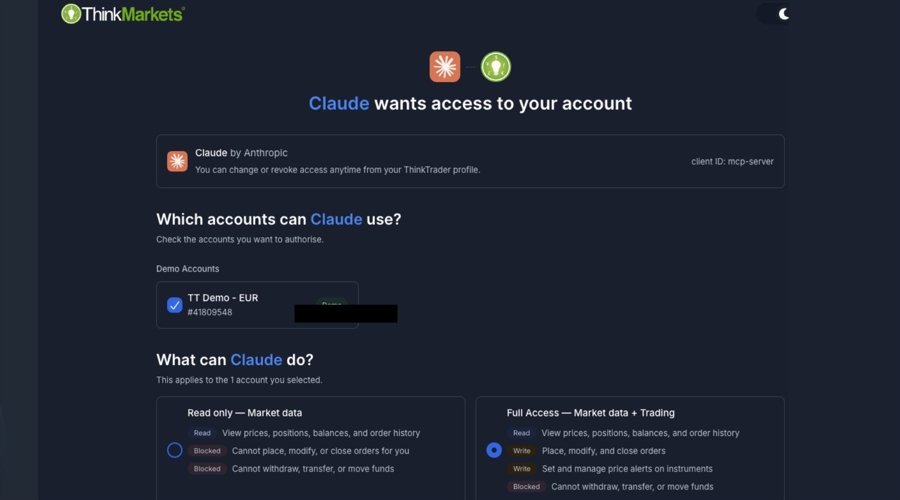
The emerging shift is from AI as a feature inside a broker’s app to AI agents that can connect to brokerage accounts, analyse portfolios and submit orders. Interactive Brokers’ announcement of autonomous trading is one example of this, while Scalable Capital’s decision to open its platform to major AI assistants is another.
Related: How Brokers Get Shortlisted by Chatbots
Brokers benefit from customer acquisition, retention, trading commissions or spreads, assets held on-platform and lower service costs. They may also differentiate themselves through execution quality, account integration and risk controls, but if AI tools become interchangeable, they could be forced to compete more aggressively on price and execution.
AI model companies and agent developers can capture value through API usage, subscriptions, enterprise contracts and control of the interface through which investors discover opportunities and initiate trades. However, inference costs, competition between models and dependence on brokerage APIs may constrain margins or weaken bargaining power.
Investors may be able to analyse more instruments, automate routine portfolio tasks and implement rules-based strategies without coding. They may also save time and reduce certain execution errors. Of course, better analysis does not guarantee better returns since subscription charges, poor decisions, transaction costs and excessive trading can absorb the benefit.
The FCA highlighted the issue of who controls the customer interface in its Mills Review, warning that AI could shift market power towards firms that control consumer interfaces, customer data and the agents through which people make financial decisions.
Condor Capital Wealth Management’s Q2 2026 digital advice report examined AI agents connected to funded brokerage accounts. It found capable tools but also substantial setup friction and unresolved questions about reliability, security and liability, although the researchers stressed that their tests were short and their results were not a definitive measure of future performance.
Meanwhile, the Bank of England and FCA’s October 2026 survey found that 86% of responding financial services firms used AI, but only 7% of reported AI systems were classified as highly material to their businesses.
This survey covered financial services broadly rather than retail brokers specifically, so it should be treated as an indicator of the gap between adoption and material business impact rather than direct evidence of broker profitability.
The central story is not simply who makes money from AI. It is whether AI shifts bargaining power away from the broker towards the company that mediates the trader’s decisions and whether brokers can retain enough of the customer relationship to justify their investment.
There are a number of areas of retail trading where AI could deliver a real competitive advantage. One obvious example is customer acquisition and retention, where AI assistants can help brokers attract technically sophisticated traders, increase engagement and reduce churn.
London’s trading industry is coming home!
How AI Is Changing the Retail Trading Experience
Natural language screeners, portfolio analysis, earnings interpretation and automated execution can make a complex platform easier to use. In October, Interactive Brokers introduced autonomous trading that lets eligible clients authorise connected AI to submit supported orders within defined parameters.
AI has the ability to automate customer support, onboarding, research and routine account queries. This may be the most immediate economic opportunity, particularly for brokers serving international markets across multiple languages and time zones, although the specific advantage depends on whether savings exceed model, integration, monitoring and compliance costs.
The strongest use case is probably combining AI with proprietary market data, reliable execution, account information, risk controls and a seamless trading workflow – but that is harder to reproduce than adding an AI assistant to an existing app.
There are three major flaws in the competitive advantage argument, the first of which is that the technology is becoming widely available. If every broker can integrate similar foundation models, the AI feature itself may not differentiate one platform for long.
Secondly, engagement is not the same as value. More app visits, queries and trades do not necessarily mean higher retention, greater customer lifetime value or better returns for clients. The test is whether AI users stay longer, deposit more or become more profitable customers to serve.
In addition, the economics may favour someone else. If traders increasingly use third-party AI assistants to compare platforms, research markets and execute trades, the broker risks becoming a replaceable execution and custody provider rather than owning the customer relationship.
Read more: Getting to Know your (AI) Agent
The UK FCA raised this possibility in its July 2026 Mills Review, warning that AI agents could shift competitive power towards firms controlling the customer interface and that AI-mediated product comparisons could weaken traditional brand loyalty.
The regulator suggested that while some firms may thrive in a world where AI agents compare products and make choices on consumers’ behalf, others may struggle to adapt as firms increasingly need to appeal to AI agents programmed to optimise for price, value, risk or fit rather than brand loyalty or marketing.
In other words, AI might make trading easier while making brokers themselves less differentiated.
The Mills Review explores how AI could reshape retail financial services for consumers, firms, markets and regulators.
The findings and recommendations from the independent report build on the FCA’s strong foundations and how we can harness AI to deliver better outcomes for consumers and maintain trust in financial services.
https://t.co/mlYHx7v7hN
#FCAGrowth #AI #AIFinance #FinancialServices #FinancialRegulation
— Financial Conduct Authority (@TheFCA) July 6, 2026
The Economic Impact on Different Broker Models
As for what AI does to broker economics, the answer will differ considerably between CFD/forex brokers and share trading platforms. The former stand to gain from better risk analytics, multilingual support, trading tools and retention while potentially being exposed to higher trading activity without sustainable customer value and increased conduct and compliance risks.
ETF brokers have to balance the merits of easier research, portfolio management and automated investing against features becoming commoditised as price competition intensifies, while multi-asset brokers benefit from cross-asset discovery, integrated analytics and a more useful single account but also face additional complexity and cost.
The most revealing evidence of how AI is paying for itself comes from internal performance data rather than AI adoption surveys. However, it should also be taken into account that customers who choose AI tools may already be more engaged or technologically sophisticated, so brokers would need to control for these differences before claiming that AI itself improves retention or profitability.
On the question of who actually captures the economic value of AI in retail trading, the answer is that everyone can capture value, just at different points in the chain – and the party that captures the most value may not be the one investing the most in AI.
Who Will Capture the Economic Value of AI?
The emerging shift is from AI as a feature inside a broker’s app to AI agents that can connect to brokerage accounts, analyse portfolios and submit orders. Interactive Brokers’ announcement of autonomous trading is one example of this, while Scalable Capital’s decision to open its platform to major AI assistants is another.
Related: How Brokers Get Shortlisted by Chatbots
Brokers benefit from customer acquisition, retention, trading commissions or spreads, assets held on-platform and lower service costs. They may also differentiate themselves through execution quality, account integration and risk controls, but if AI tools become interchangeable, they could be forced to compete more aggressively on price and execution.
AI model companies and agent developers can capture value through API usage, subscriptions, enterprise contracts and control of the interface through which investors discover opportunities and initiate trades. However, inference costs, competition between models and dependence on brokerage APIs may constrain margins or weaken bargaining power.
Investors may be able to analyse more instruments, automate routine portfolio tasks and implement rules-based strategies without coding. They may also save time and reduce certain execution errors. Of course, better analysis does not guarantee better returns since subscription charges, poor decisions, transaction costs and excessive trading can absorb the benefit.
The FCA highlighted the issue of who controls the customer interface in its Mills Review, warning that AI could shift market power towards firms that control consumer interfaces, customer data and the agents through which people make financial decisions.
Condor Capital Wealth Management’s Q2 2026 digital advice report examined AI agents connected to funded brokerage accounts. It found capable tools but also substantial setup friction and unresolved questions about reliability, security and liability, although the researchers stressed that their tests were short and their results were not a definitive measure of future performance.
Meanwhile, the Bank of England and FCA’s October 2026 survey found that 86% of responding financial services firms used AI, but only 7% of reported AI systems were classified as highly material to their businesses.
This survey covered financial services broadly rather than retail brokers specifically, so it should be treated as an indicator of the gap between adoption and material business impact rather than direct evidence of broker profitability.
The central story is not simply who makes money from AI. It is whether AI shifts bargaining power away from the broker towards the company that mediates the trader’s decisions and whether brokers can retain enough of the customer relationship to justify their investment.