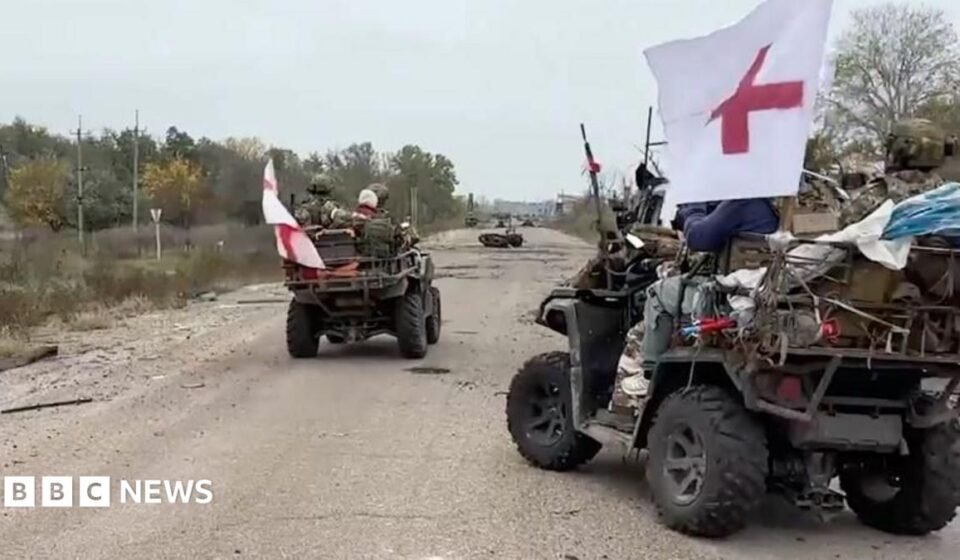

Lubinets and his Russian counterpart Yana Lantratova travelled to Oleshky together on Friday. Lantratova later posted a video on social media from the town, saying people were given the chance to form two groups depending on whether they wanted to be taken to Russian-controlled territory or to Ukraine.
In videos posted by his own social media account, Lubinets can be seen meeting tearful locals. “The problem is that a lot of people are staying,” he can be heard saying. “I was told that it was their own choice, we will do everything possible for the humanitarian aid to arrive.”
Russia said on Thursday that it had prepared “dozens of tonnes” of aid for the residents who do not wish to leave, including food, medicine, hygiene products and fuel for generators.
An Oleshky resident told the BBC she had decided decided against leaving because “they wouldn’t take my animals, so that’s it.”
Olena, who now lives in Kyiv, said her grandmother and wider family in Oleshky were also staying behind.
“The older generation does not want to leave,” she told the BBC. “I’ve barely managed to persuade my father – and only because I’ve just had a baby, who he would never see otherwise.”
Her grandmother’s sister died in Oleshky last winter.
“She lost her legs after stepping on a landmine, covered in snow… People took her to the hospital in a garden wheelbarrow,” Olena said.
“That’s how locals transport all wounded and dead people in Oleshky to the hospital and the hospital’s morgue: in garden wheelbarrows.”
The ceasefire is due to be in force until the end of Sunday 1 November. It has provided the first few days of peace in the Kherson region since the start of Russia’s full-scale invasion of Ukraine in February 2022.