
The FCA has finalised changes to the UK’s transaction
reporting regime following a consultation last year. The regulator estimates
that the industry currently spends £493 million annually on transaction
reporting and expects the reforms to save more than £100 million a year.
These are arguably the most significant changes to UK MiFIR
transaction reporting since MiFID II came into force in 2018.
London’s trading industry is coming home!
That is welcome news. However, anyone who has been through
EMIR Refit will know that simplification does not necessarily mean less work.
Changes to reporting schemas, new
validation rules and months of regression testing can quickly offset some
of the expected savings.
Much of the reduction in trade repository charges
could be absorbed by the personnel time required to adjust to the new
specifications.
The main changes fall into three areas: what firms must
report, which instruments fall within scope and how far back firms must correct
reporting errors.
Quinn Perrott, Co-CEO, TRAction
The number of reportable fields will fall from 65 to 52.
Trading venues will also no longer need to provide 11 instrument reference data
fields.
The scope of reporting will become narrower, with around
seven million instruments that are tradable only on EU venues removed from UK
reporting requirements.
Another significant change concerns FX derivatives, which
will be removed from MiFIR transaction reporting altogether. The FCA considers
UK EMIR a more appropriate reporting framework for this data. The
change is expected to reduce costs for more than 400 UK firms while
removing duplication.
The maximum period for correcting historical reporting
errors will also fall from five years to three. In addition, the exemption for
corporate events will be widened, although IPOs, secondary offerings, placings
and debt issuance will remain reportable.
For retail FX and CFD brokers, the removal of FX derivatives
from MiFIR reporting is arguably the most important change. Reporting the same
transaction under two separate regimes, using different formats and sending the
data to different destinations, has long been one of the less defensible
aspects of the UK reporting framework.
Why Does FIRDS Becoming the Golden Source Matter?
The FCA has confirmed that its Financial Instruments
Reference Data System will become the
definitive source for determining whether an instrument is reportable. A clear
seven-day cut-off after execution will also apply.
In practice, this should remove the need for firms to keep
checking whether an instrument has entered FIRDS and become reportable after a
transaction has taken place.
However, placing greater reliance on FIRDS also increases
the importance of data governance. Firms will need to understand where their
reference data comes from, how frequently it is refreshed and who is
responsible for managing it internally.
The FCA is also addressing reporting requirements for
derivatives on indices, where determining whether a transaction is reportable
can be difficult. Firms will be allowed to voluntarily over-report these
transactions.
For
many brokers, reporting all transactions in this category may prove simpler
and less expensive than developing systems to determine which ones fall outside
the reporting requirements.
Will Conditional Single-Sided Reporting Deliver Real
Relief?
PS26/15 introduces a new Conditional Single-Sided Reporting
framework. Its purpose is to allow more firms to rely on reporting arrangements
with counterparties instead of reporting the same transaction twice.
The
direction is welcome, but there are reasons to question how much relief the
framework will deliver in practice. Several buy-side respondents told the FCA
that they were sceptical about its potential benefits.
Delegating reporting responsibilities to a counterparty may
appear straightforward. However, it requires accurate data sharing, clearly
defined responsibilities and appropriate contractual arrangements. Without
these elements, firms risk replacing one operational burden with another.
Ultimately, the framework’s value will depend on the
conditions attached to it and how easily firms can meet them.
When Do the Changes Take Effect?
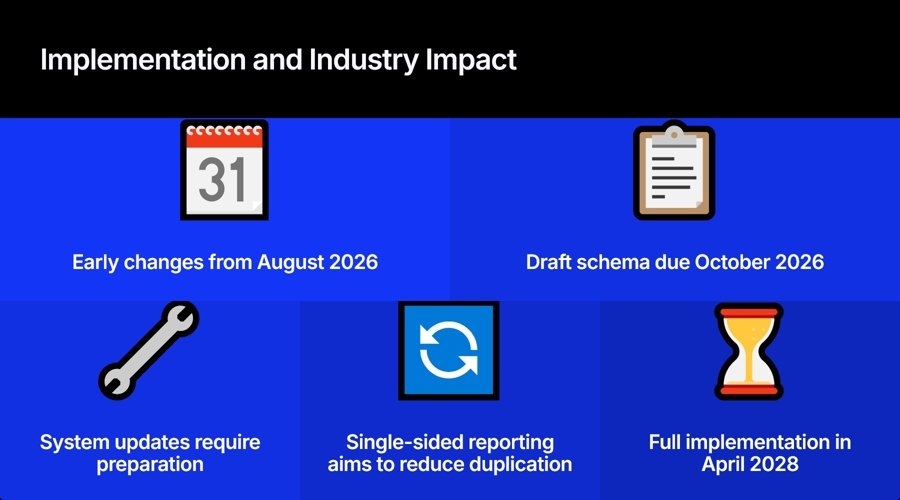
The new reporting regime will become fully effective on 3
April 2028. However, firms should pay attention to three dates in the
implementation timeline.
From 3 August 2026, the FCA is adopting a flexible
supervisory approach across a defined list of areas. Firms will not face
enforcement action for adopting several of the changes early. The shorter
three-year back-reporting period also applies from this date.
In October 2026, the FCA is expected to publish a draft
schema, validation rules and updated guidance. Together, these documents will
form the Transaction Reporting User Pack.
Full implementation will follow on 3 April 2028.
The October 2026 publication is particularly important.
Until firms have access to the revised schema and validation rules, they can
assess the scope of system changes but cannot begin building against the final
technical specifications.
Why Does This Matter Beyond MiFIR?
The reforms are also part of a broader effort to simplify
regulatory reporting in the UK.
The FCA and the Bank of England have established a joint
Transaction and Post-trade Reporting Industry Harmonisation Taskforce. Its
objective is to develop a single reporting framework covering UK MiFIR, UK EMIR
and UK SFTR.
The underlying principle is straightforward: firms should
only have to report data once.
This could eventually address some of the overlap between
the three reporting regimes. Firms should therefore expect further
consultations as regulators explore ways to harmonise their requirements.
How Should Firms Prepare?
Although the FCA does not require firms to take immediate
action, the scale of the changes and the time needed to implement them make it
unwise to wait until 2028.
Reporting teams and their external service providers should
already be reviewing their existing arrangements.
In particular, firms should:
- Review
reporting logic against the revised scope, with particular attention to FX
derivatives and instruments traded exclusively on EU venues. - Assess
data governance arrangements and reference data sources ahead of FIRDS
becoming the definitive source for determining reportability. - Check
whether correction and back-reporting procedures reflect the new
three-year limit, which already applies. - Monitor
the publication of the October 2026 schema and validation rules, and
allocate sufficient time and resources for the necessary system changes.
PS26/15 represents a step towards a leaner UK transaction
reporting regime. The expected reduction in reporting costs is welcome,
particularly for firms that have had to manage overlapping requirements across
different regulatory frameworks.
However, the savings will not come automatically. Firms
still face the work of updating systems, reviewing data processes and ensuring
that their reporting arrangements meet the revised requirements.
Those that use the next 18 months to review their data, map
reporting flows and prepare for the technical changes should be in a better
position to benefit from the reforms. Those that wait until 2028 risk turning a
simplification exercise into another last-minute compliance project.
The FCA has finalised changes to the UK’s transaction
reporting regime following a consultation last year. The regulator estimates
that the industry currently spends £493 million annually on transaction
reporting and expects the reforms to save more than £100 million a year.
These are arguably the most significant changes to UK MiFIR
transaction reporting since MiFID II came into force in 2018.
London’s trading industry is coming home!
That is welcome news. However, anyone who has been through
EMIR Refit will know that simplification does not necessarily mean less work.
Changes to reporting schemas, new
validation rules and months of regression testing can quickly offset some
of the expected savings.
Much of the reduction in trade repository charges
could be absorbed by the personnel time required to adjust to the new
specifications.
The main changes fall into three areas: what firms must
report, which instruments fall within scope and how far back firms must correct
reporting errors.
Quinn Perrott, Co-CEO, TRAction
The number of reportable fields will fall from 65 to 52.
Trading venues will also no longer need to provide 11 instrument reference data
fields.
The scope of reporting will become narrower, with around
seven million instruments that are tradable only on EU venues removed from UK
reporting requirements.
Another significant change concerns FX derivatives, which
will be removed from MiFIR transaction reporting altogether. The FCA considers
UK EMIR a more appropriate reporting framework for this data. The
change is expected to reduce costs for more than 400 UK firms while
removing duplication.
The maximum period for correcting historical reporting
errors will also fall from five years to three. In addition, the exemption for
corporate events will be widened, although IPOs, secondary offerings, placings
and debt issuance will remain reportable.
For retail FX and CFD brokers, the removal of FX derivatives
from MiFIR reporting is arguably the most important change. Reporting the same
transaction under two separate regimes, using different formats and sending the
data to different destinations, has long been one of the less defensible
aspects of the UK reporting framework.
Why Does FIRDS Becoming the Golden Source Matter?
The FCA has confirmed that its Financial Instruments
Reference Data System will become the
definitive source for determining whether an instrument is reportable. A clear
seven-day cut-off after execution will also apply.
In practice, this should remove the need for firms to keep
checking whether an instrument has entered FIRDS and become reportable after a
transaction has taken place.
However, placing greater reliance on FIRDS also increases
the importance of data governance. Firms will need to understand where their
reference data comes from, how frequently it is refreshed and who is
responsible for managing it internally.
The FCA is also addressing reporting requirements for
derivatives on indices, where determining whether a transaction is reportable
can be difficult. Firms will be allowed to voluntarily over-report these
transactions.
For
many brokers, reporting all transactions in this category may prove simpler
and less expensive than developing systems to determine which ones fall outside
the reporting requirements.
Will Conditional Single-Sided Reporting Deliver Real
Relief?
PS26/15 introduces a new Conditional Single-Sided Reporting
framework. Its purpose is to allow more firms to rely on reporting arrangements
with counterparties instead of reporting the same transaction twice.
The
direction is welcome, but there are reasons to question how much relief the
framework will deliver in practice. Several buy-side respondents told the FCA
that they were sceptical about its potential benefits.
Delegating reporting responsibilities to a counterparty may
appear straightforward. However, it requires accurate data sharing, clearly
defined responsibilities and appropriate contractual arrangements. Without
these elements, firms risk replacing one operational burden with another.
Ultimately, the framework’s value will depend on the
conditions attached to it and how easily firms can meet them.
When Do the Changes Take Effect?
The new reporting regime will become fully effective on 3
April 2028. However, firms should pay attention to three dates in the
implementation timeline.
From 3 August 2026, the FCA is adopting a flexible
supervisory approach across a defined list of areas. Firms will not face
enforcement action for adopting several of the changes early. The shorter
three-year back-reporting period also applies from this date.
In October 2026, the FCA is expected to publish a draft
schema, validation rules and updated guidance. Together, these documents will
form the Transaction Reporting User Pack.
Full implementation will follow on 3 April 2028.
The October 2026 publication is particularly important.
Until firms have access to the revised schema and validation rules, they can
assess the scope of system changes but cannot begin building against the final
technical specifications.
Why Does This Matter Beyond MiFIR?
The reforms are also part of a broader effort to simplify
regulatory reporting in the UK.
The FCA and the Bank of England have established a joint
Transaction and Post-trade Reporting Industry Harmonisation Taskforce. Its
objective is to develop a single reporting framework covering UK MiFIR, UK EMIR
and UK SFTR.
The underlying principle is straightforward: firms should
only have to report data once.
This could eventually address some of the overlap between
the three reporting regimes. Firms should therefore expect further
consultations as regulators explore ways to harmonise their requirements.
How Should Firms Prepare?
Although the FCA does not require firms to take immediate
action, the scale of the changes and the time needed to implement them make it
unwise to wait until 2028.
Reporting teams and their external service providers should
already be reviewing their existing arrangements.
In particular, firms should:
- Review
reporting logic against the revised scope, with particular attention to FX
derivatives and instruments traded exclusively on EU venues. - Assess
data governance arrangements and reference data sources ahead of FIRDS
becoming the definitive source for determining reportability. - Check
whether correction and back-reporting procedures reflect the new
three-year limit, which already applies. - Monitor
the publication of the October 2026 schema and validation rules, and
allocate sufficient time and resources for the necessary system changes.
PS26/15 represents a step towards a leaner UK transaction
reporting regime. The expected reduction in reporting costs is welcome,
particularly for firms that have had to manage overlapping requirements across
different regulatory frameworks.
However, the savings will not come automatically. Firms
still face the work of updating systems, reviewing data processes and ensuring
that their reporting arrangements meet the revised requirements.
Those that use the next 18 months to review their data, map
reporting flows and prepare for the technical changes should be in a better
position to benefit from the reforms. Those that wait until 2028 risk turning a
simplification exercise into another last-minute compliance project.